How Wickey Achieved a 14x Conversion Lift in its US Market Launch with Useberry

•
4 min read
See how Wickey used Useberry’s remote user testing platform to recruit participants, run user research, validate key product decisions for its US market entry, and achieve a 14x lift in conversions.
Introduction
Wickey is a leading European manufacturer of outdoor playground equipment, with over 25 years of experience designing high-quality playsets for both residential and commercial use. Known for its German-engineered products, the company has built a strong presence across Europe and was preparing to expand into the United States market.
The research was led by Dave Powell, Senior CRO at Wickey, who brought over 15 years of commercial and growth experience to the project. The initiative focused on ensuring Wickey’s US market entry was backed by real customer validation rather than assumptions.
The Task
Wickey’s goal was to successfully enter the US market with a product lineup that resonated with local customers, without taking on the significant risks associated with physical inventory, logistics, and product development.
Launching in a new market presented several challenges. Without prior validation, there was a high risk of selecting the wrong product mix, mispricing offerings, or prioritizing features that didn’t align with customer expectations. Given the cost of manufacturing and shipping large physical products, getting it wrong would be expensive.
The core research goal was to validate product appeal, identify key feature drivers, and determine optimal pricing before committing to inventory and launch decisions.
To achieve this, Wickey recruited 452 US-based parents through Useberry’s Participant Pool who:
had children aged 2–10
owned a backyard
were actively considering outdoor play equipment
The study was designed as a multi-phase, mixed-method research project using Useberry, combining:
preference testing
survey-based price sensitivity analysis
feature-driven qualitative feedback
realistic concept testing with pricing and product details
For example, participants were asked to compare different playground sets in a tournament-style format and explain their choices, allowing the team to uncover not just which products performed best—but why.
The Challenge
Wickey needed to make high-stakes decisions in a completely new market, where assumptions could not be trusted. Even when a product has already proven successful in one market, entering a new one can reveal very different customer expectations. During its initial market entry, conversion rates declined from 0.03% to 0.02%, highlighting the risk of relying on assumptions in a new audience. The challenge was not just to improve performance, but to de-risk future launch decisions by understanding which products, features, and price points would actually resonate with US customers before making major inventory and go-to-market investments.
The key challenge was to de-risk a physical product launch before committing resources, including:
selecting the right product lineup
identifying must-have features
setting pricing that matched customer expectations
ensuring demand existed before investing in inventory
Additionally, the team needed a solution that could:
quickly recruit a highly specific audience in a new geography
support a flexible, multi-step research design
deliver high-quality, decision-ready data
The Solution
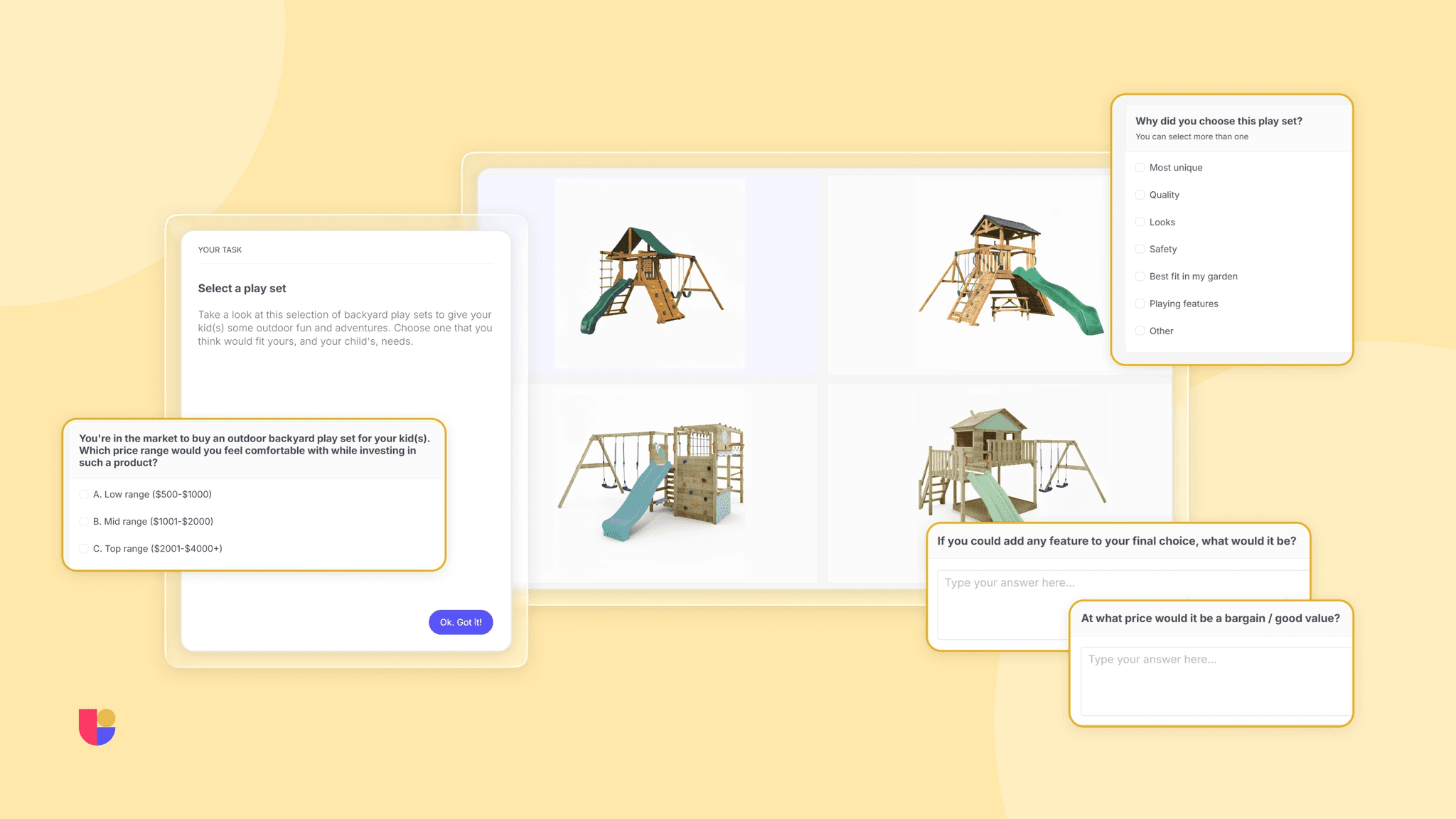
To address these challenges, Wickey used Useberry to design a structured, multi-phase research flow that simulated real purchasing decisions.
Using Useberry’s Participant Pool, the team was able to recruit a highly targeted US audience in minutes, ensuring the study reflected real market conditions:
The research itself combined multiple methods into a single cohesive study:
1. Preference Testing (Tournament Comparisons)
Participants compared different playground sets in a tournament-style format, though preference testing, allowing Wickey to identify which concepts generated the strongest initial appeal.
2. Feature Analysis
After each selection, participants provided feedback on why they preferred certain options. This revealed the key drivers of purchase intent, such as:
climbing features and monkey bars
slide variations
swing configurations
overall play complexity
3. Price Sensitivity Research
Using survey-based pricing techniques, Wickey evaluated how demand shifted across different price ranges, highlighting where perceived value aligned (or conflicted) with cost.
4. Realistic Concept Testing
Finally, products were presented with full context, including price, size, and materials; to simulate real-world decision-making conditions and validate final purchase intent.
The flexibility of Useberry allowed the team to fully customize the study flow, ensuring a seamless participant experience and high-quality data output:
The Results
The study provided Wickey with clear, data-backed direction for its US market entry, transforming uncertainty into confident decision-making.
Key Outcomes
452 qualified US participants provided statistically significant insights
Clear identification of top-performing product concepts
Discovery of key feature drivers (e.g. climbing elements, swing variety, slides, shade)
Critical insight into how pricing reshapes demand, with some products gaining or losing appeal once price was introduced
One particularly important finding was that product preference changed significantly when pricing was revealed, highlighting the importance of testing both emotional appeal and economic reality.
Business Impact
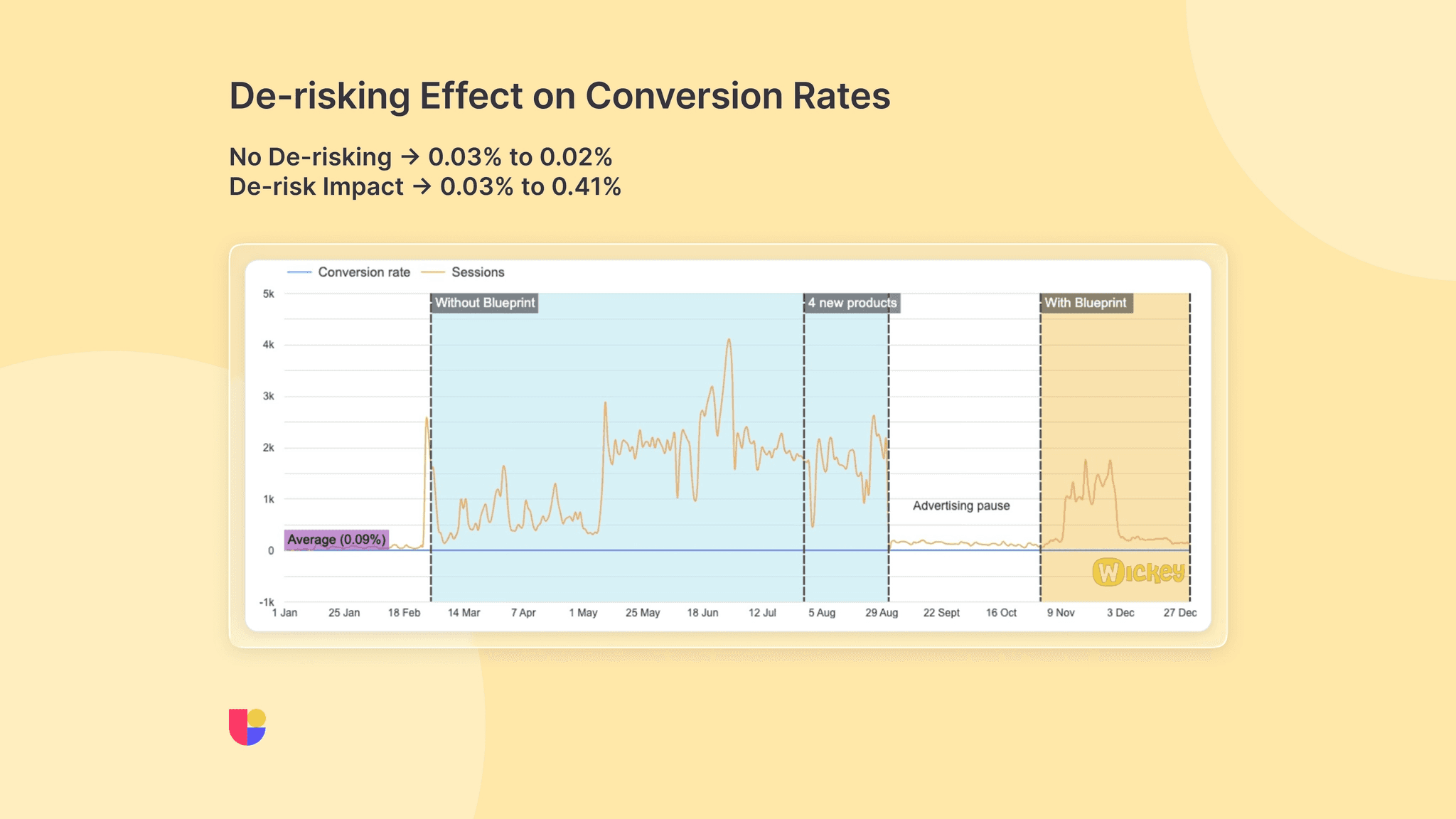
By validating product selection, pricing, and messaging before launch, Wickey was able to significantly improve performance outcomes:
What began as a decline in conversion from 0.03% to 0.02% turned into a massive rise to 0.41% once Wickey validated product decisions through research
Equivalent to a ~14x improvement in conversion rate
This demonstrated the direct impact of research-led decision-making:
👉 Products validated through structured research performed significantly better
👉 Products launched without validation underperformed
Beyond performance metrics, the research enabled Wickey to:
reduce guesswork in go-to-market decisions
prioritize high-impact product features
confidently invest in inventory and logistics
accelerate time-to-market with reduced risk